protect-your-innovation

Don’t Leave It Too Late: How Security Helps Start-ups Grow

The best time to protect your innovation is before anyone else wants it. The second best time is now.

Over the last two weeks I have written about why early-stage tech is a target and what a funded security review actually includes. In this final piece, I want to look at what happens afterwards, because that is where the real value lies.

From a security review to new business

The clearest example so far comes from North Product Design (NPD), a product design agency that took part in the Secure Innovation Security Review scheme.

Following its review, NPD put in place a tailored security action plan and strengthened both its physical and cyber security. According to the company, the review helped it understand its risks and identify practical steps to address them.

The commercial result is what stands out. NPD reported that the improvements helped it demonstrate a stronger level of assurance to major organisations, supporting its work in the defence supply chain. It also described the review as a stronger foundation for growth, including expanding its team and facilities. You can read the full NPD case study on Innovate UK Business Connect.

That is the point I keep coming back to. Security is not a brake on growth. Done well, it is part of how you earn the trust that growth depends on.

Why it pays to protect your innovation early

Security is far cheaper to build in than to bolt on. A five-person company can set good habits around who gets access, how data is shared and how new people are vetted in an afternoon. A fifty-person company has to unpick years of workarounds first.

Timing matters for a second reason. The moment a start-up begins talking to large customers, defence primes or serious investors, it is asked to prove its security. If the answer is still being worked out at that point, deals slow down or stall.

There is also the threat itself. Hostile states and competitors are most interested in a technology before it is widely known, when it is valuable and still lightly protected. Waiting until you feel big enough to be a target usually means waiting too long.

What happens during a review

For founders wondering what to expect, here is how I approach a Secure Innovation Security Review.

Listen first. I start with your business, not a checklist: what you are building, who you are selling to, where you want to be in two years, and what keeps you up at night.

Find what matters most. Together we answer three questions. What are you protecting? What are you protecting it from? How vulnerable is it? For most tech companies, the answer to the first is broader than the code. It includes people, partners, premises and know-how.

Look across the whole picture. We cover governance, culture, people, physical security, supply chains, incident management and cyber, because an adversary will use whichever route is easiest.

Prioritise honestly. You leave knowing what matters now, what can wait, and what to do next, in a plan that fits your team and your budget.

Check progress. Six months later we meet again to review what has changed and agree the next steps.

Protect your innovation before you need to

The scheme is open now to UK-registered companies with fewer than 250 people, working in the sensitive sectors set out under the National Security and Investment Act. Funding is limited and allocated on a first-come, first-served basis.

When you apply through Innovate UK Business Connect, you can read the profiles of the Approved Reviewers and choose who you would like to work with. If you would like that to be me, look for Paul Mercer on the list, or get in touch if you would like to talk it through first.

When your first major customer asks how you protect your innovation, what will you tell them?

This article was written with AI assistance.

start-up-security-review

£500 for a £3,000 Security Review: What Founders Actually Get

Security is usually sold to founders as a cost. Done properly, it is a sales asset. A start-up security review under the government’s Secure Innovation scheme is one of the simplest ways I know to test that idea, because the government pays most of the bill.

Last week I explained what the Secure Innovation Security Review is and who can apply. This week I want to look at what you actually get for your £500, and why I think it is worth more than the price suggests.

What does a start-up security review include?

The review is valued at £3,000. Your company contributes £500, including VAT, and government funds the remaining £2,500. For that, you receive:

  • an in-person review with an Approved Reviewer
  • a confidential, tailored report with practical recommendations
  • a £300 Cyber Essentials voucher
  • a follow-up session six months later to check progress and agree next steps

The review covers far more than IT. It looks at governance, security culture, risk management, supply chains and partnerships, incident management, and physical and personnel security, as well as cyber.

The report stays confidential. It is shared only with the small number of government bodies that run the scheme.

One thing to be clear about: the funding covers the review itself, not the cost of putting the recommendations in place. A good reviewer keeps that in mind and recommends what your business can realistically do.

Why the Cyber Essentials voucher matters

Cyber Essentials is the government-backed baseline for cyber security. It covers a small set of technical controls that protect against the most common online attacks, such as phishing and password guessing.

The certificate itself is modest. What it opens up is not. A growing number of organisations, including many UK government buyers, expect suppliers to hold Cyber Essentials before they will award a contract. For a start-up chasing its first large customer, that can be the difference between being on the shortlist and not.

The £300 voucher covers much of the cost of getting there. You can read more about the standard on the NCSC Cyber Essentials pages.

Security as a sales asset

Large customers and serious investors ask about security early. It shows up in supplier questionnaires, in procurement checks and in investor due diligence. A founder who can answer those questions clearly, and show they have had an independent review and acted on it, builds confidence quickly.

I see this from the other side too. HawkSight sells to large organisations, and holding ISO 27001 has made those conversations far easier. Security that you can evidence is security that helps you sell.

It is worth being honest about the limits. The review is not a certification, and there is no badge at the end. But you can tell customers and investors that you have completed one, and explain what you have done since. That is often a more convincing answer than a logo.

What a good start-up security review should leave you with

The value of any review lies in what happens next. A long list of findings that nobody has time to address helps no one. What a founder needs is a short, prioritised plan: what matters now, what can wait, and what to do next.

That plan should fit the size of your team and your budget. Each action should have an owner. And the six-month follow-up gives you a natural point to check progress, rather than letting the report gather dust.

How to get started

The scheme is open to UK-registered companies with fewer than 250 people, working in the sensitive sectors set out under the National Security and Investment Act. Funding is limited and allocated on a first-come, first-served basis.

When you apply through Innovate UK Business Connect, you can read the profiles of the Approved Reviewers and choose who you would like to work with. If you would like that to be me, look for Paul Mercer on the list, or get in touch first if you have questions.

If a major customer sent you their supplier security questionnaire tomorrow, how confidently could you answer it?

This article was written with AI assistance.

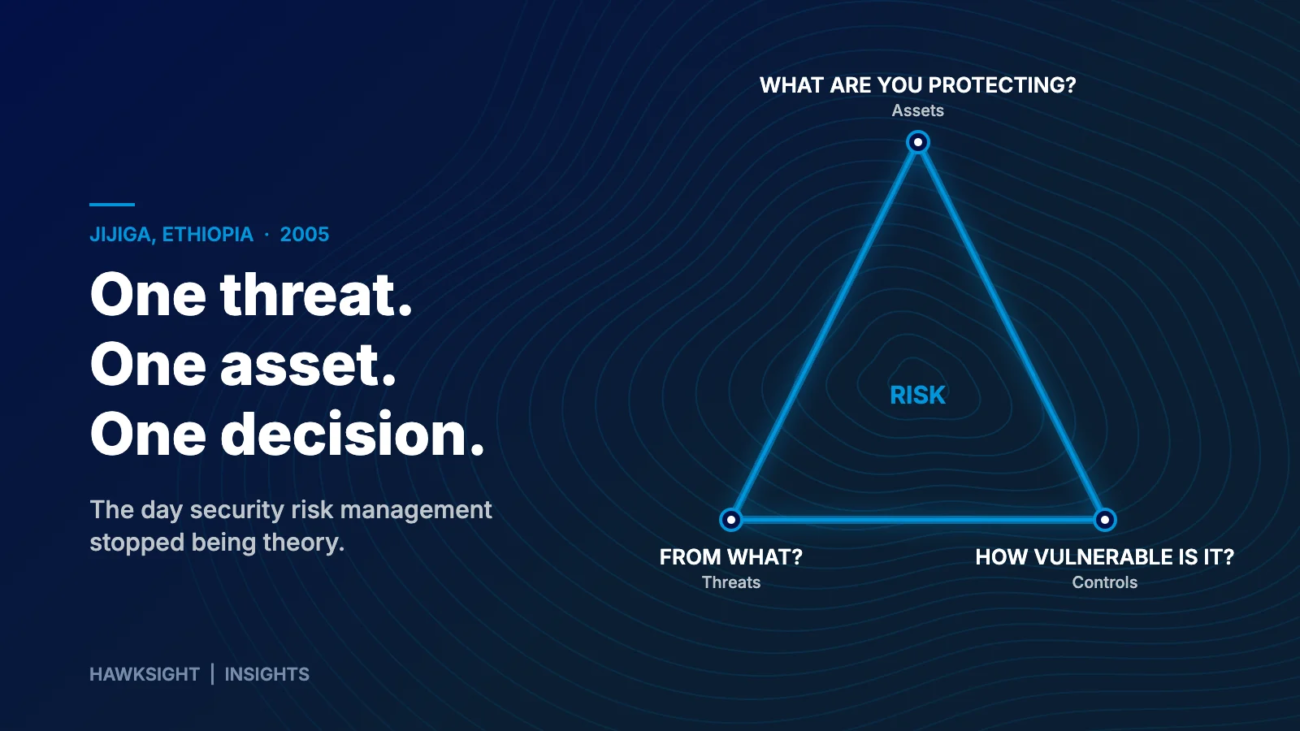
Dynamic risk assessment triangle: what are you protecting, from what, and how vulnerable is it, Jijiga, Ethiopia, 2005

One Threat, One Asset, One Decision

The moment I really understood security risk management was not in a classroom. It was during the 2005 elections in Ethiopia, two weeks into a new job, and it came down to a single dynamic risk assessment.

I had joined the Carter Center as security adviser for its election observation mission. My area ran from Jijiga down to the Somali border, covering every observation post in between. As the capital of Ethiopia’s Somali Region, Jijiga was the most significant of those posts, and the one that mattered most to the results.

The 2005 elections were the most competitive Ethiopia had seen, and they were tense. Within weeks of the national vote, protests over the results turned deadly in Addis Ababa, and the unrest that followed left around 200 people dead.

Preparing the people I was responsible for

The observers were civilians, volunteering their time so that the elections could be independently scrutinised. My job was to keep them safe.

The week before the elections, I travelled the region with one of the Carter Center’s social scientists to review each observation post. Through a British university that had carried out a study in the area, I arranged to meet a tribal chief. We explained who we were, what we were doing and what our vehicles and branding would look like, and asked for peaceful right of transit. He offered us military protection. I had to decline: our credibility as observers depended on staying neutral.

That ground reconnaissance shaped the security plan, including the evacuation routes from each post to a safe location. Back in Addis Ababa, I set up a makeshift operations centre and training environment in a hotel. As the observers arrived, I trained them to operate safely in the field, to use satellite communications, to conduct themselves and to report. I linked the operations centre with the security teams of other agencies and the government bodies we could reach, creating an intelligence-sharing network. Once the observers deployed, we monitored their movements from there, with air assets ready to extract people and get them to hospital if something went wrong.

None of that is unusual. It is the normal work of a security adviser: prepare, put controls in place, and be ready to respond. What I had not yet done was make a call that tested all of it, live.

Election day in Jijiga

On election day, reports came in from our team in Jijiga. The main voting centre had opened later than planned, and as the hours passed, the crowd’s patience wore thin. Local security officers fired shots to control it, and an older woman was shot and killed.

My pre-deployment research and the ground recce had already told me a good deal about the area. Tribal tensions, political rivalries and unresolved disputes ran deep, and many people nearby had access to firearms and even explosives. The conditions for a violent reaction were all there.

A dynamic risk assessment, made from the operations room

I was hundreds of miles away, working only from what the team was reporting. So I worked through the same three questions I would ask in any security risk assessment.

What was I trying to protect? Our observer team in Jijiga.

What was I trying to protect it from? A violent response to her shooting. Several groups now had a motive for revenge: her family, her tribe and, increasingly, the politics of the day. And I knew all of them had the capability, with access to both small arms and explosives.

How vulnerable were they? Very. They were at the focal point of the tension, with little between them and whatever came next.

One asset. One threat. A clear and rapidly worsening vulnerability. That was a dynamic risk assessment I could carry out in my head, and the answer was plain: the risk now outweighed the value of staying.

A structured conversation with leadership I had never met

The harder part was the conversation that followed. Observing the election mattered. It was the reason we were there, and a transparent democratic process depended on people like us being present. I was asking the organisation to pull its team out of the most important post in the region, two weeks into the job.

First, I took my assessment to the Carter Center’s in-country leadership, who asked me to put it directly to the leadership at headquarters in Atlanta. I had never met them. One of the first things they asked was whether I had specific intelligence that an attack was going to take place.

I didn’t. Events were moving too fast for that. But the process gave me something just as useful. I could set out what we were protecting, what we faced and how exposed the team was. The motive was there, the capability was there, and the team was in the middle of it. I could tell them what the risk was. And I could tell them I couldn’t give them a single reason why it wouldn’t happen.

It was a calm conversation, not an alarmed one, and it gave them what they needed to decide. They authorised an immediate evacuation from Jijiga.

Getting them out before dark

Our team in Jijiga was two people. One was a former Kenyan special forces soldier, very capable in his own right. The other was a British social scientist who spoke the local dialect. Both had every reason to read the situation differently from someone in an operations room hundreds of miles away, and I wondered whether they would push back.

They didn’t. I had the same conversation with them that I’d had with Atlanta, built on the same three questions, and it landed with both of them in exactly the same way.

Then time became the issue. On the recce, we had mapped the evacuation route from Jijiga to a pre-planned safe hotel, and along it we had identified a likely ambush point. Intelligence told us that anyone passing it after dark stood a good chance of being carjacked. They had to move quickly to get through it in time.

They made it, and checked into the hotel. I remember thinking I was unlikely to be very popular: I had just cancelled the mission at its most important post. They were sitting down to eat when the call came through the intelligence-sharing network we had built. A device had gone off at the election observation post in Jijiga.

What that dynamic risk assessment taught me

That was the day the theory became real for me. The structured process I had been taught was not paperwork. Used properly, under pressure, it let me reach the right answer quickly and, just as importantly, explain it to people who had every reason to question it, whether that was a leadership team I had never met, a former special forces soldier or an academic who knew the area far better than I did.

Four things made the difference:

  • Understanding the operation, what was at stake and my client’s appetite for risk.
  • Assessing the threat in a logical way my client could follow.
  • Communicating the risk clearly and simply, so leadership could act.
  • Having a plan ready: a reconnoitred route, a safe destination, and the timing to get there.

From one threat to thousands

Here is the point I keep coming back to. That day I was dealing with one threat against one asset, in a very tangible situation. A dynamic risk assessment on that scale is something you can hold in your head.

Businesses don’t have that luxury. A security leader has to weigh many threats against many assets, across sites and countries, physical and cyber, while meeting compliance obligations and reporting to a board. Asking one person, or a team working from spreadsheets, to hold all of that in their heads simply isn’t feasible.

That is why I have spent more than a decade building the HawkSight platform, first as a digital framework and now with AI-enabled threat intelligence through Talon. The scale has changed. The fundamentals haven’t. Every assessment still comes back to the same three questions: what am I trying to protect, what am I trying to protect it from, and how vulnerable is it?

The question for you

If you had to make that call today, from an operations room and on the strength of a few reports, could you explain your reasoning to a leadership team you had never met? And could you do it across every site and every threat you are responsible for?

If you’d like to talk about how HawkSight brings that structure to your organisation, get in touch.