The moment I really understood security risk management was not in a classroom. It was during the 2005 elections in Ethiopia, two weeks into a new job, and it came down to a single dynamic risk assessment.
I had joined the Carter Center as security adviser for its election observation mission. My area ran from Jijiga down to the Somali border, covering every observation post in between. As the capital of Ethiopia’s Somali Region, Jijiga was the most significant of those posts, and the one that mattered most to the results.
The 2005 elections were the most competitive Ethiopia had seen, and they were tense. Within weeks of the national vote, protests over the results turned deadly in Addis Ababa, and the unrest that followed left around 200 people dead.
Preparing the people I was responsible for
The observers were civilians, volunteering their time so that the elections could be independently scrutinised. My job was to keep them safe.
The week before the elections, I travelled the region with one of the Carter Center’s social scientists to review each observation post. Through a British university that had carried out a study in the area, I arranged to meet a tribal chief. We explained who we were, what we were doing and what our vehicles and branding would look like, and asked for peaceful right of transit. He offered us military protection. I had to decline: our credibility as observers depended on staying neutral.
That ground reconnaissance shaped the security plan, including the evacuation routes from each post to a safe location. Back in Addis Ababa, I set up a makeshift operations centre and training environment in a hotel. As the observers arrived, I trained them to operate safely in the field, to use satellite communications, to conduct themselves and to report. I linked the operations centre with the security teams of other agencies and the government bodies we could reach, creating an intelligence-sharing network. Once the observers deployed, we monitored their movements from there, with air assets ready to extract people and get them to hospital if something went wrong.
None of that is unusual. It is the normal work of a security adviser: prepare, put controls in place, and be ready to respond. What I had not yet done was make a call that tested all of it, live.
Election day in Jijiga
On election day, reports came in from our team in Jijiga. The main voting centre had opened later than planned, and as the hours passed, the crowd’s patience wore thin. Local security officers fired shots to control it, and an older woman was shot and killed.
My pre-deployment research and the ground recce had already told me a good deal about the area. Tribal tensions, political rivalries and unresolved disputes ran deep, and many people nearby had access to firearms and even explosives. The conditions for a violent reaction were all there.
A dynamic risk assessment, made from the operations room
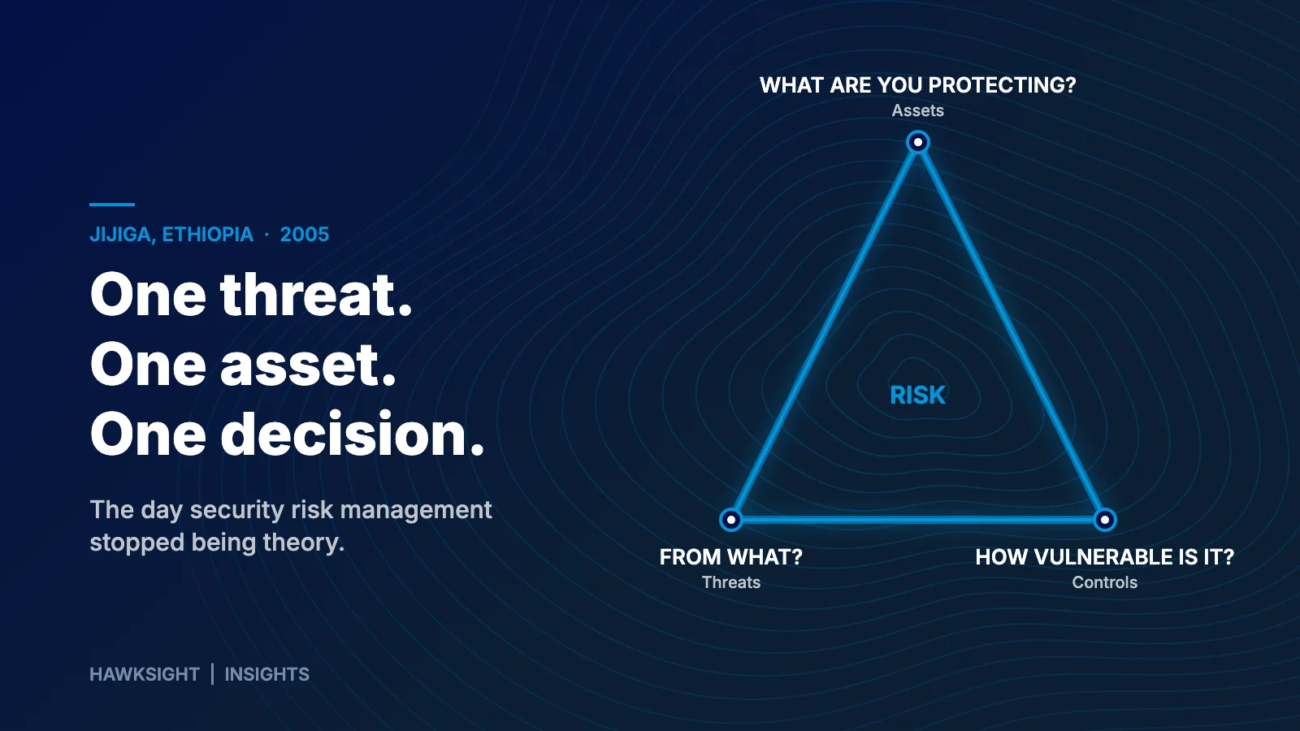
I was hundreds of miles away, working only from what the team was reporting. So I worked through the same three questions I would ask in any security risk assessment.
What was I trying to protect? Our observer team in Jijiga.
What was I trying to protect it from? A violent response to her shooting. Several groups now had a motive for revenge: her family, her tribe and, increasingly, the politics of the day. And I knew all of them had the capability, with access to both small arms and explosives.
How vulnerable were they? Very. They were at the focal point of the tension, with little between them and whatever came next.
One asset. One threat. A clear and rapidly worsening vulnerability. That was a dynamic risk assessment I could carry out in my head, and the answer was plain: the risk now outweighed the value of staying.
A structured conversation with leadership I had never met
The harder part was the conversation that followed. Observing the election mattered. It was the reason we were there, and a transparent democratic process depended on people like us being present. I was asking the organisation to pull its team out of the most important post in the region, two weeks into the job.
First, I took my assessment to the Carter Center’s in-country leadership, who asked me to put it directly to the leadership at headquarters in Atlanta. I had never met them. One of the first things they asked was whether I had specific intelligence that an attack was going to take place.
I didn’t. Events were moving too fast for that. But the process gave me something just as useful. I could set out what we were protecting, what we faced and how exposed the team was. The motive was there, the capability was there, and the team was in the middle of it. I could tell them what the risk was. And I could tell them I couldn’t give them a single reason why it wouldn’t happen.
It was a calm conversation, not an alarmed one, and it gave them what they needed to decide. They authorised an immediate evacuation from Jijiga.
Getting them out before dark
Our team in Jijiga was two people. One was a former Kenyan special forces soldier, very capable in his own right. The other was a British social scientist who spoke the local dialect. Both had every reason to read the situation differently from someone in an operations room hundreds of miles away, and I wondered whether they would push back.
They didn’t. I had the same conversation with them that I’d had with Atlanta, built on the same three questions, and it landed with both of them in exactly the same way.
Then time became the issue. On the recce, we had mapped the evacuation route from Jijiga to a pre-planned safe hotel, and along it we had identified a likely ambush point. Intelligence told us that anyone passing it after dark stood a good chance of being carjacked. They had to move quickly to get through it in time.
They made it, and checked into the hotel. I remember thinking I was unlikely to be very popular: I had just cancelled the mission at its most important post. They were sitting down to eat when the call came through the intelligence-sharing network we had built. A device had gone off at the election observation post in Jijiga.
What that dynamic risk assessment taught me
That was the day the theory became real for me. The structured process I had been taught was not paperwork. Used properly, under pressure, it let me reach the right answer quickly and, just as importantly, explain it to people who had every reason to question it, whether that was a leadership team I had never met, a former special forces soldier or an academic who knew the area far better than I did.
Four things made the difference:
- Understanding the operation, what was at stake and my client’s appetite for risk.
- Assessing the threat in a logical way my client could follow.
- Communicating the risk clearly and simply, so leadership could act.
- Having a plan ready: a reconnoitred route, a safe destination, and the timing to get there.
From one threat to thousands
Here is the point I keep coming back to. That day I was dealing with one threat against one asset, in a very tangible situation. A dynamic risk assessment on that scale is something you can hold in your head.
Businesses don’t have that luxury. A security leader has to weigh many threats against many assets, across sites and countries, physical and cyber, while meeting compliance obligations and reporting to a board. Asking one person, or a team working from spreadsheets, to hold all of that in their heads simply isn’t feasible.
That is why I have spent more than a decade building the HawkSight platform, first as a digital framework and now with AI-enabled threat intelligence through Talon. The scale has changed. The fundamentals haven’t. Every assessment still comes back to the same three questions: what am I trying to protect, what am I trying to protect it from, and how vulnerable is it?
The question for you
If you had to make that call today, from an operations room and on the strength of a few reports, could you explain your reasoning to a leadership team you had never met? And could you do it across every site and every threat you are responsible for?
If you’d like to talk about how HawkSight brings that structure to your organisation, get in touch.